Homeopathic Psychiatry 2026: BHMS Doctors & Mental Health
Homeopathic Psychiatry in 2026: How BHMS Doctors Are Addressing India’s Mental Health Crisis Through Specialization
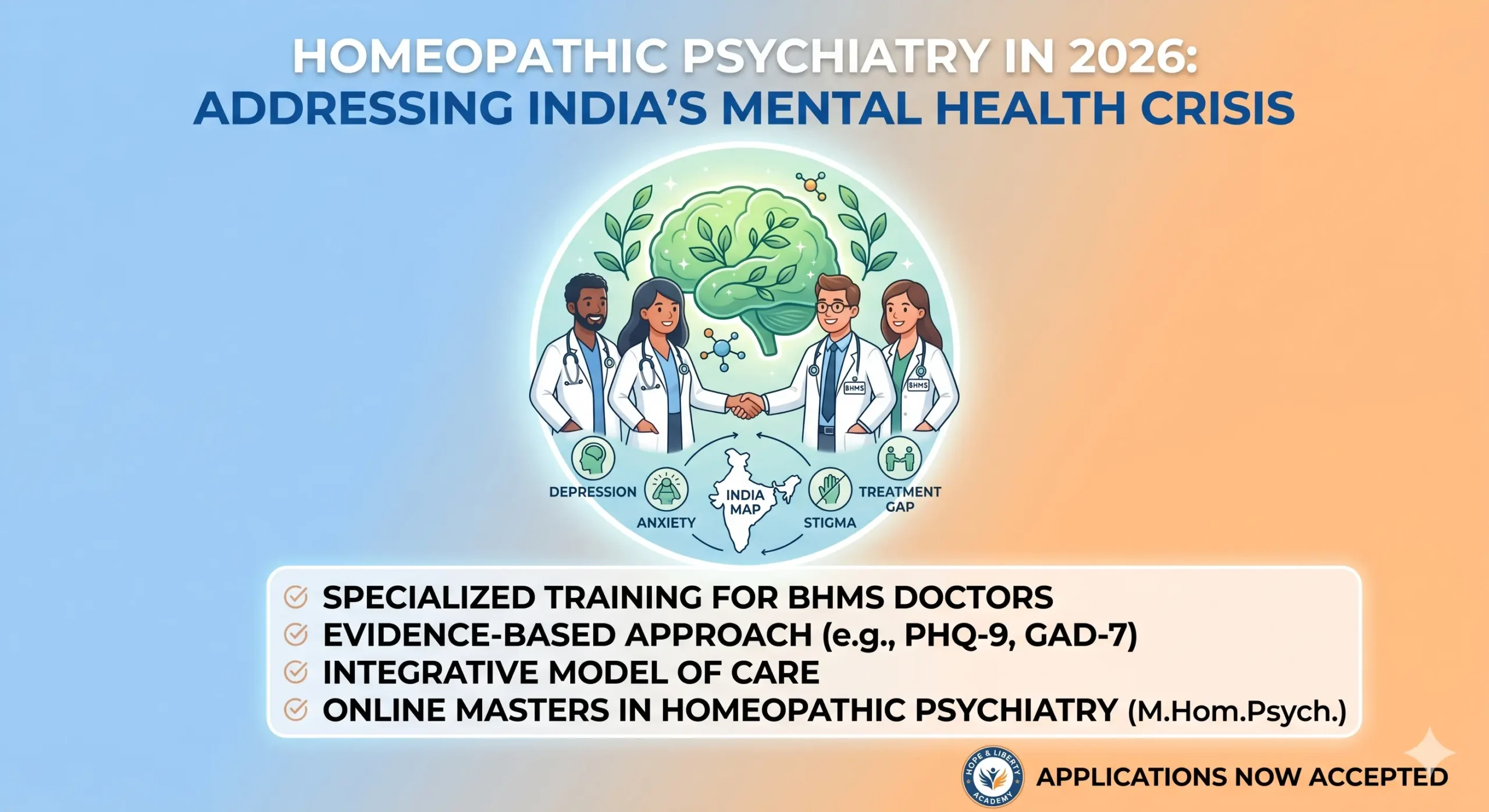
India is in the middle of a mental health emergency that very few people are talking about loudly enough. According to the Global Burden of Disease study, nearly 197 million Indians, one in every seven people in the country, live with some form of mental disorder. Depression and anxiety alone affect over 90 million people. Yet India has only 0.75 psychiatrists per 100,000 people, far below the WHO’s recommended minimum of 3. The country has just 9,000 practicing psychiatrists when it needs at least 36,000. Between 70 and 92 percent of people with mental disorders in India receive no care at all.
This is the gap that homeopathic psychiatry and the BHMS doctors who choose to specialize in it are uniquely positioned to address. But clinical intuition alone is no longer enough. What this moment calls for is formal, postgraduate subspecialty training that gives homeopathic practitioners the tools, the diagnostic language, and the evidence base to step into this space with genuine authority.
1. Why Conventional Psychiatry Cannot Bridge This Gap Alone
India’s mental health infrastructure is stretched far beyond its capacity. The majority of psychiatrists are concentrated in urban centers, leaving rural districts where over 60 percent of India’s population lives almost entirely without specialist mental health care. Even in cities, waiting times for consultation with a psychiatrist can stretch into weeks or months.
The societal picture is equally challenging. Stigma remains one of the biggest barriers to mental health care-seeking in India. The cultural weight of phrases like ‘log kya kahenge’ (what will people say) continues to prevent millions of families from seeking help until a crisis has already occurred. People who might hesitate to walk into a psychiatry outpatient department will, however, visit a trusted homeopathic doctor they have known for years.
This is not a theoretical advantage, it is a clinical reality that practicing BHMS doctors experience every single day. The question is whether those doctors have the specialized training to respond effectively when a patient presents with generalized anxiety disorder, treatment-resistant depression, or early-stage psychosis. Without formal homeopathic psychiatry training, most are not equipped to do so safely and systematically.
2. What Homeopathic Psychiatry Actually Offers: The Evidence Landscape
Homeopathic psychiatry does not position itself as a replacement for severe psychiatric intervention. It operates within an integrative model one that identifies where constitutional homeopathic prescribing offers the most meaningful clinical contribution.
The evidence base, while still evolving, is more substantial than many practitioners realize. A randomised controlled trial published in the journal Trials found a moderate treatment effect in favour of patients treated by homeopaths for self-reported depression, with results maintained at 12 months. An EPI3 cohort study, one of the largest observational studies of its kind, found that patients with anxiety and depression who consulted GPs practicing homeopathy reported lower use of psychotropic drugs and were marginally more likely to experience clinical improvement than those receiving conventional care alone. A case series published in PubMed reported an overall response rate of 58 percent for homeopathic treatment of depression and anxiety disorders.
“The mind is not separate from the body in homeopathic philosophy it never has been. Every remedy in the Materia Medica has a mental and emotional picture. What postgraduate specialization in homeopathic psychiatry does is take this foundational insight and apply it within a structured, evidence-informed clinical framework that mainstream healthcare can engage with, respect, and collaborate on.”
The areas where the clinical literature is most encouraging include anxiety disorders, mild to moderate depression, PTSD and grief responses, early-stage mood disorders, and the management of psychosomatic presentations conditions where the mind-body axis is clearly the primary driver of pathology.
3. The Clinical Framework: What Specialization Actually Teaches
The difference between a generalist homeopathic doctor who occasionally treats anxious patients and a homeopathic psychiatry specialist is not simply a matter of knowing more remedies. It is about learning to think, assess, and document in a way that is clinically rigorous and professionally defensible.
A postgraduate Masters in Homeopathic Psychiatry trains practitioners to work within a framework that conventional mental health professionals can understand and respect. This includes:
- Using validated psychiatric assessment tools such as the PHQ-9 for depression, the GAD-7 for anxiety, and the PCL-5 for PTSD to measure and document patient outcomes in numerical terms
- Understanding the DSM-5 and ICD-11 diagnostic frameworks so that you can communicate fluently with referring psychiatrists, GPs, and psychologists
- Designing a coordinated care approach knowing when to refer for pharmacotherapy, when to collaborate, and when constitutional homeopathic care can safely lead the management plan
- Building a case series with objective outcome data that can be submitted for publication turning your clinical work into evidence that advances the field
This is the clinical standard that postgraduate homeopathy courses must now deliver. General practice knowledge of homeopathic philosophy is no longer sufficient for a practitioner seeing complex psychiatric presentations in 2026.
- Why Right Now Is the Critical Moment for BHMS Doctors to Specialize
India’s National Mental Health Programme, the Mental Healthcare Act 2017, and the expansion of programmes like Tele-MANAS and the District Mental Health Programme have fundamentally changed the institutional landscape. Mental health is now explicitly recognized as a public health priority at the highest levels of government. AYUSH practitioners including homeopathic doctors are increasingly being considered as part of the broader solution to India’s mental health treatment gap.
This is not a future opportunity. It is a present one. BHMS doctors who develop subspecialty expertise in homeopathic psychiatry right now are positioning themselves at the leading edge of a healthcare transformation that will define the next decade of integrative practice in India and globally.
The practical career implications are significant as well. A homeopathic doctor with a documented postgraduate specialization in psychiatry can build a differentiated clinical reputation in a way that a generalist simply cannot. They can attract referrals from GPs and counsellors, participate in institutional mental health programmes, and build a patient base that values and seeks out their specific expertise.
5. The Masters in Homeopathic Psychiatry at Hope & Liberty Academy
The Masters in Homeopathic Psychiatry (M. Hom. Psych) at Hope & Liberty Academy of Health Sciences is designed specifically for practicing BHMS doctors who want to build genuine subspecialty expertise without pausing their clinical career.
The programme is delivered entirely online across four structured semesters, covering advanced psychiatric Materia Medica, constitutional case analysis in complex presentations, integration of validated outcome measurement tools, and a supervised Semester 4 research component that produces a publishable case series or prospective study.
Every graduate of the M. Hom. Psych programme leaves with three career assets that generalist practice cannot provide:
- A formally recognized postgraduate subspecialty credential in homeopathic psychiatry
- A peer-reviewed research publication through the Journal of Scientific and Clinical Homeopathy (JSCH)
- A direct pathway to PhD programme eligibility in Health Sciences and Integrative Medicine globally
The next intake opens in July 2026. Applications for January 2027 are now being accepted at hlmservices.org.
Conclusion: The Practitioner India Needs Right Now
India’s mental health crisis is real, it is vast, and it is not going away. The country needs more mental health practitioners at every level of care and homeopathic doctors, with their deep understanding of the mind-body connection and their trusted presence in communities across the country, have a genuine and meaningful role to play.
But that role requires preparation. It requires the clinical depth, the diagnostic vocabulary, and the evidence-based framework that only postgraduate homeopathic psychiatry specialization can provide. For BHMS doctors who are ready to step into this space to do the work that India’s mental health crisis genuinely needs, the Masters in Homeopathic Psychiatry is the professional foundation that makes it possible.
Frequently Asked Questions
Q1. Can homeopathy genuinely help patients with depression and anxiety?
The clinical evidence is encouraging, particularly for mild to moderate presentations and psychosomatic cases. A randomised controlled trial published in Trials found a moderate positive treatment effect for homeopathically treated depression patients, with results maintained at 12 months. The EPI3 cohort study found lower psychotropic drug use and marginal clinical improvement in patients treated by homeopaths versus conventional care. Homeopathic psychiatry does not claim to replace pharmacotherapy in severe conditions; it operates within an integrative framework where each modality contributes where it is most effective.
Q2. What is the difference between general homeopathic practice and homeopathic psychiatry specialization?
General homeopathic practice gives you the foundational Materia Medica and philosophy to prescribe constitutionally. Homeopathic psychiatry specialization goes further; it trains you to use validated psychiatric assessment tools like the PHQ-9 and GAD-7, understand DSM-5 and ICD-11 diagnostic criteria, coordinate care with conventional mental health professionals, and produce publishable clinical research. It is the difference between treating anxious patients and being recognized as a subspecialist in mental health care.
Q3. Is the Masters in Homeopathic Psychiatry available online for practicing doctors in India?
Yes. The M. Hom. Psych programme at Hope & Liberty Academy of Health Sciences is delivered entirely online, designed so that practicing BHMS doctors can continue their clinical work throughout the two-year programme. There are no campus attendance requirements. The flexible delivery structure is designed around the schedules of working practitioners.
Q4. How does India’s mental health crisis create an opportunity for homeopathic doctors specifically?
India has a treatment gap of 70 to 92 percent meaning the vast majority of people with mental disorders receive no professional care. The shortage of conventional psychiatrists is severe, and stigma prevents many patients from approaching mainstream mental health services. Trusted homeopathic doctors already embedded in communities are uniquely positioned to provide first-line integrative mental health support but only if they have the subspecialty training to do so safely and effectively.
Q5. Does completing the M. Home. Does the Psychiatry programme qualify me for doctoral research?
Yes. The Semester 4 original research dissertation in the M. Hom. programme is structured to produce the research prerequisite that PhD admissions committees globally require. Graduates leave with a Masters-level subspecialty credential and a peer-reviewed publication, making them directly eligible to apply for doctoral programmes in Health Sciences, Integrative Medicine, and related disciplines internationally.