How to Evaluate an Online Homeopathy Master’s Course Before You Enrol
Choosing an online Master’s in Homeopathy is not simply a matter of comparing course fees, duration or the number of modules on a website.
For a practising homeopathic doctor, the more important question is:
What will this course actually add to my professional and academic development?
Two programs can both describe themselves as postgraduate courses while offering very different learning experiences. One may be largely theoretical, while another may include clinical practice, case work and research. One may have clear accreditation and eligibility requirements, while another may leave important details unclear.
Before enrolling, it is worth looking beyond the course brochure.
1. Start with the qualification itself
The first thing to establish is exactly what qualification you will receive.
Do not rely only on phrases such as:
- Master’s-level program
- International qualification
- Postgraduate degree
- Advanced homeopathy course
Ask for the precise qualification title and awarding or accrediting body.
Also check whether the institution clearly explains:
- the qualification awarded
- the duration
- the credit structure
- entry requirements
- assessment requirements
- accreditation
- clinical requirements
- research requirements
A transparent institution should not make you piece together these details from several different pages.
2. Check accreditation, but understand what it means
Accreditation is one of the first things prospective students should verify.
However, accreditation and professional recognition are not necessarily the same thing.
Find out:
Who accredits the program?
What exactly is accredited?
Does the accreditation apply to the institution, the specific program or both?
Can the accreditation be independently verified?
For example, HLMS describes its postgraduate programs as CMA-accredited. Prospective students should still distinguish that accreditation from recognition or registration requirements that may apply in their own country.
This distinction becomes particularly important for doctors considering an international qualification while intending to continue practising in India.
A useful rule is:
Never assume that one body’s accreditation automatically means another country’s professional regulator recognizes the qualification.
Those are separate questions and should be checked separately.
3. Look at the eligibility requirements
A serious postgraduate program should be clear about who can enrol.
Check whether the program requires:
- BHMS or another homeopathy qualification
- clinical experience
- professional registration
- a diploma plus additional experience
- proof of current licensure
- other academic prerequisites
The requirements can tell you something about the level of the program.
A course designed specifically for practising doctors may have very different entry requirements from a general introductory course marketed to anyone interested in homeopathy.
For HLMS, the published course information specifies eligibility based on prior homeopathy or medical education, clinical experience and professional registration/licensure, depending on the applicant’s qualification pathway.
That is worth checking against the current admissions requirements before applying.
4. Don’t judge an online course by the word “online”
Online delivery is a format, not a measure of academic quality.
The better question is:
What happens during those online semesters?
Look for information about:
- live or recorded teaching
- case discussions
- academic assessments
- faculty interaction
- clinical work
- supervision
- research
- feedback
- examinations or other evaluation methods
A course consisting primarily of recorded lectures is very different from one that combines structured academic learning with clinical application and research.
For a doctor who is already practising, this distinction can make a significant difference.
5. Find out how much of the program is actually clinical
This is one of the most important questions to ask before enrolling in a postgraduate homeopathy course.
A Master’s-level program should make its relationship with clinical practice clear.
Ask:
Is there clinical practice?
When does it begin?
How are cases handled?
Is there supervision or guidance?
How is clinical learning assessed?
Is clinical documentation part of the program?
At HLMS, the four-semester structure separates the learning journey into two broad phases. The first two semesters focus on academic learning, while the latter two include clinical practice and research-paper work.
That progression matters because it connects theory with application rather than treating the two as unrelated parts of the course.
6. Look beyond the list of subjects
A curriculum can look impressive simply because it contains a long list of subjects.
Instead of counting modules, look at what you are expected to do with the knowledge.
For example, does the program involve:
- case analysis
- medical history taking
- critical thinking
- clinical problem-solving
- specialty-focused study
- research methodology
- academic writing
- outcome assessment?
HLMS describes its postgraduate programs as incorporating case studies, medical history taking, critical thinking and problem-solving alongside specialty-focused academic learning.
That gives a prospective student more useful information than simply seeing a long syllabus.
7. Who is teaching you?
Faculty can tell you a great deal about the quality and orientation of a postgraduate program.
Look for actual names rather than generic descriptions such as “experienced professionals.”
Check:
- academic qualifications
- clinical experience
- specialization
- research experience
- publications
- professional registration
- teaching experience
For example, HLMS identifies Dr. Suhas Kotbagi as a faculty figure with MD (WI), DIHom (UK), HMD (UK), R. Hom (Canada), MBA and PGDip in Gastroenterology, along with three decades of clinical experience.
That is much more useful to a prospective student than simply being told that the faculty are “highly experienced.”
8. Ask what happens in the final semesters
This is where many course comparisons become superficial.
Don’t just ask:
“How long is the Master’s?”
Ask:
“What will I actually be doing during the final part of it?”
For HLMS, the latter two semesters include clinical practice and research-paper work.
That creates a progression from academic learning toward practical and research-oriented work.
A prospective student should understand:
- what clinical work involves
- what is expected from the research paper
- how the research topic is selected
- whether guidance is provided
- what format the final submission takes
- whether publication is required or optional
These details can tell you much more about the academic depth of the program than the course duration alone.
9. Research should not be an afterthought
If you are considering postgraduate education, find out whether research is genuinely part of the program or simply mentioned in the marketing material.
Ask:
Will I formulate a research question?
Will I work with published literature?
Will I collect or analyse clinical information?
Will I write a research paper?
Is there academic guidance?
This matters because postgraduate education should ideally develop the ability to question, investigate and evaluate clinical knowledge, not simply consume it.
A research component can also give practising doctors an opportunity to explore a specialty-specific question in greater depth.
10. Check how the institution talks about professional scope
This is particularly important when comparing international programs.
Be cautious of claims suggesting that completing a qualification automatically makes you:
- a specialist
- a consultant
- eligible for a new professional licence
- entitled to use a particular professional designation
- legally permitted to practise in another country
An academic qualification and professional registration are different things.
HLMS itself states that graduates should not misrepresent themselves as specialists. That is an important distinction for prospective students to understand.
The safest approach is to treat the qualification, accreditation and professional registration as three separate questions:
What qualification am I earning?
Who accredits or recognizes it?
What does my professional regulator allow me to do with it?
11. Check recognition in the country where you intend to practise
This deserves its own section because international online education creates a common point of confusion.
If you are an Indian homeopathic doctor considering an international Master’s, do not stop at:
“Is this course accredited?”
You should also ask:
“How is this qualification treated by the professional authorities in the country where I practise?”
For India, that means checking the current requirements of the National Commission for Homoeopathy (NCH) and the relevant State Homoeopathy Council.
A foreign qualification may have academic value without automatically creating a new right to practise or use a professional title.
This is why recognition should be verified before enrolment rather than after graduation.
12. Compare the research and clinical components, not just the price
Course fees are easy to compare.
Academic depth is harder.
Suppose Course A costs less but provides only theoretical learning.
Course B costs more but includes structured clinical work, case discussions, research and academic supervision.
The cheaper course is not automatically better value.
For a practising doctor, compare the program using a wider framework:
Academic depth + clinical exposure + research + faculty + accreditation + professional relevance
Then consider the cost.
This produces a much more meaningful comparison than looking only at the number on the fee page.
13. Ask what you will be able to demonstrate at graduation
This may be the best question of all.
Instead of asking:
“What certificate will I receive?”
ask:
“What will I actually be able to demonstrate when I finish?”
A strong postgraduate program should leave you with evidence of development in areas such as:
- specialty knowledge
- clinical case analysis
- structured documentation
- critical thinking
- research
- academic writing
- understanding of your professional scope
The certificate is the formal outcome.
The capability you develop during the program is the more meaningful one.
A simple checklist before you enrol
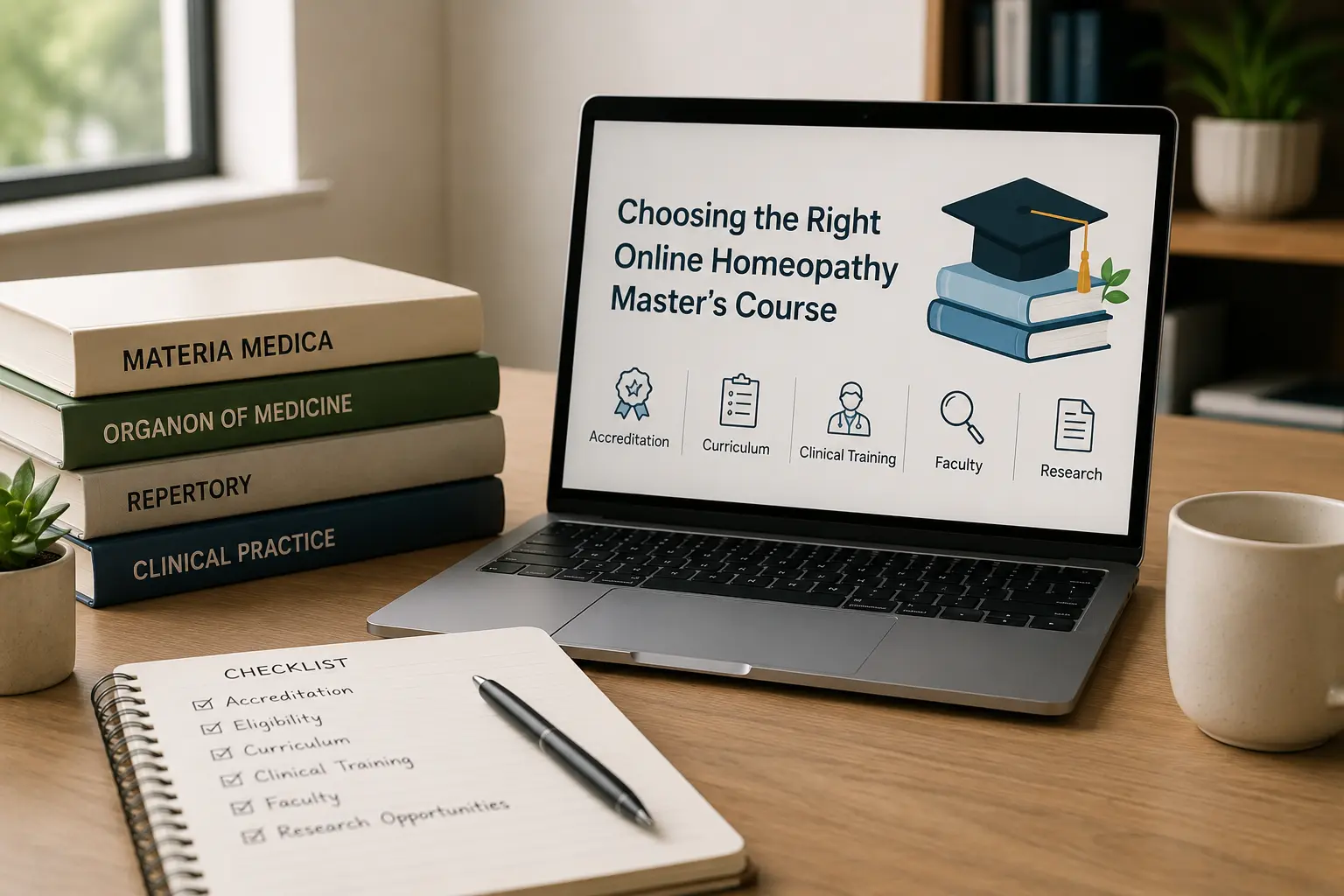
Before committing to an online Master’s in Homeopathy, verify these points:
- Qualification: What exactly will I receive?
- Accreditation: Who accredits the program?
- Eligibility: Do I meet the academic and clinical requirements?
- Faculty: Who actually teaches the program?
- Curriculum: What will I study?
- Clinical component: How much practical learning is included?
- Research: Is a research paper or project required?
- Assessment: How is my learning evaluated?
- Duration: What does each semester involve?
- Recognition: How is the qualification treated where I intend to practise?
- Professional scope: What can and cannot I claim after graduation?
- Documentation: Will I receive clear academic records and supporting documents?
If a course provider cannot answer these questions clearly, that is worth considering before you enrol.
The right course is not necessarily the one with the longest syllabus
A postgraduate course can have dozens of modules and still provide a shallow learning experience.
Another can have a more focused curriculum and provide much greater depth through clinical work, case analysis and research.
For a practising homeopathic doctor, the important question is not:
“How much content is included?”
It is:
“How much deeper will I become in the area I have chosen?”
That is the real purpose of postgraduate education.
An online format can make advanced education more accessible to doctors who are already practising. But accessibility should not replace academic scrutiny.
Before enrolling, look past the promotional language.
Check the qualification, accreditation, faculty, clinical training, research component, professional recognition and actual learning outcomes.
That small amount of due diligence can make the difference between choosing a course because it sounds impressive and choosing one because you understand exactly what it offers.
Frequently Asked Questions
Is an online Master’s in Homeopathy worth pursuing?
It can be valuable for practising doctors who want advanced specialty knowledge, clinical exposure and research experience. The value depends on the program’s structure, accreditation, faculty and professional relevance.
What should I check before choosing an online homeopathy Master’s course?
Check the qualification awarded, accreditation, eligibility requirements, curriculum, faculty, clinical component, research requirements, assessment process and recognition in the country where you intend to practise.
Is CMA accreditation the same as NCH recognition?
No. CMA accreditation and NCH recognition are separate matters. An international accreditation should not automatically be interpreted as professional recognition by an Indian statutory regulator.
Does an online course include clinical practice?
Not necessarily. Programs differ considerably. Prospective students should specifically ask whether clinical practice is included, when it begins and how it is structured and assessed.
Do postgraduate homeopathy courses include research?
Some do. The exact requirements vary. Check whether the program includes a research paper, research project, academic supervision or publication requirement rather than relying on a general statement that it has a “research component.”
Can I call myself a specialist after completing a Master’s in Homeopathy?
A postgraduate qualification does not automatically determine your legal professional title or scope of practice. Professional designations, registration and practice rights depend on the applicable regulations in your jurisdiction.
What is more important when comparing online Master’s programs: duration or curriculum?
Curriculum and learning outcomes are more useful measures than duration alone. A four-semester course with meaningful clinical and research components can offer a very different experience from a program that is primarily theoretical.
Should Indian doctors verify a foreign qualification before enrolling?
Yes. Doctors planning to practise in India should check the current NCH requirements and applicable State Homoeopathy Council rules before enrolling in an international qualification. Recognition and registration should be verified independently.