
Evidence-Based Practice in Homeopathy: What Should a Postgraduate Doctor Actually Know?
A postgraduate doctor does not need to agree with every paper they read.
They do need to know how to read it, question it and understand what it actually tells them.
That distinction matters in homeopathy because the evidence surrounding the field is complex and contested. A doctor working at postgraduate level should be able to separate a clinical observation from scientific evidence, recognize the strengths and weaknesses of different study designs, and avoid making claims that go beyond the available data.
This is what evidence-based practice in homeopathy should mean: not blindly accepting research, and not dismissing it because it challenges an existing belief.
It means learning how to work with evidence.
What does evidence-based practice actually mean?
Evidence-based practice is often reduced to a simple idea:
“Follow the evidence.”
In reality, clinical decision-making is more nuanced.
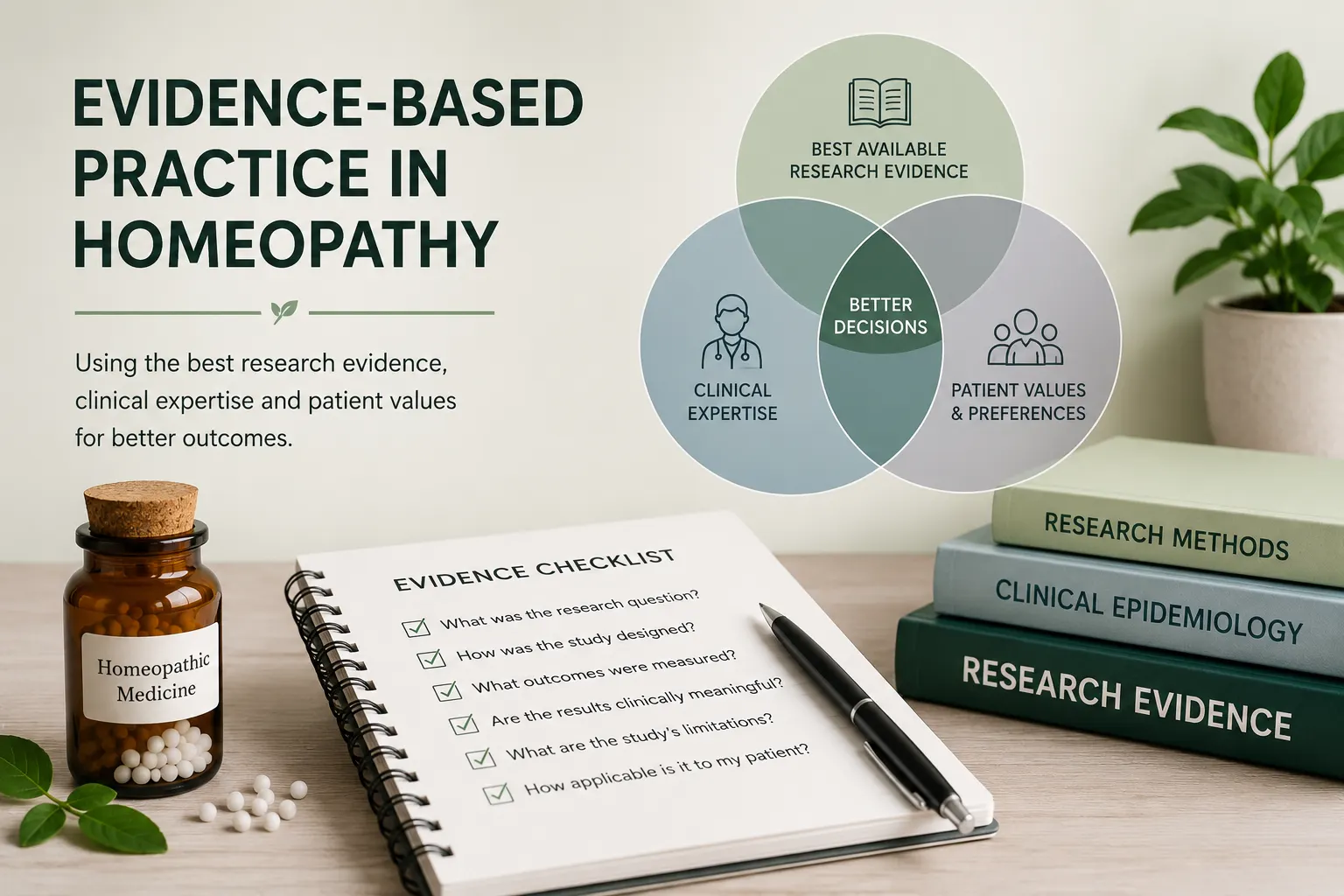
Evidence-based practice generally involves bringing together:
- the best available research evidence
- clinical expertise
- the patient’s circumstances, preferences and values
For a postgraduate homeopathic doctor, this means clinical experience remains relevant, but it should not be treated as proof by itself.
A doctor may have seen a patient improve after a particular intervention.
That is a clinical observation.
It becomes something different when the observation is systematically investigated, measured and compared with appropriate alternatives.
Understanding that difference is one of the foundations of postgraduate medical education.
Why is evidence particularly important in homeopathy?
Homeopathy has a long clinical tradition, but its effectiveness remains scientifically disputed.
The U.S. National Center for Complementary and Integrative Health (NCCIH) currently states that there is little evidence supporting homeopathy as an effective treatment for any specific health condition. It also notes that a 2015 Australian government assessment found no reliable evidence of effectiveness after applying predefined methodological criteria to the evidence base. (NCCIH)
A postgraduate doctor should know this.
But knowing the conclusion is only the beginning.
The more important academic question is:
How did researchers arrive at that conclusion?
What studies were included?
How were they selected?
What outcomes were measured?
How large were the studies?
How rigorous were the methods?
Were the findings consistent?
What limitations did the researchers identify?
That is where evidence literacy becomes valuable.
Not all research evidence carries the same weight
Finding a paper on Google does not automatically mean you have found strong evidence.
Different types of research answer different questions and have different limitations.
A simplified hierarchy might include:
Systematic reviews and meta-analyses
These synthesize findings from multiple studies using a defined methodology.
Randomized controlled trials
These can help evaluate the effects of an intervention under controlled conditions.
Observational studies
These can identify associations and patterns in real-world populations but generally cannot establish causation in the same way as a well-designed randomized trial.
Case series and case reports
These can be valuable for describing unusual presentations or generating hypotheses, but they cannot by themselves establish treatment effectiveness.
Expert opinion
Clinical expertise can be valuable, but expert opinion is not equivalent to controlled research evidence.
The important point is not that one type of evidence is always “good” and another always “bad.”
It is that the research question and study design need to match.
A case report can raise a question. It cannot settle it.
Imagine a doctor documents a patient whose symptoms improved after homeopathic treatment.
That case may be worth documenting.
It may even generate an interesting research question.
But the case alone cannot establish that the treatment caused the improvement.
There could be other explanations.
The condition may have fluctuated naturally.
Other treatments may have contributed.
The patient’s perception may have changed.
The original diagnosis may have been uncertain.
This is why postgraduate research training matters.
It teaches doctors to move from:
“I observed this.”
to:
“How could I investigate this properly?”
Learn to ask what a study actually measured
One of the easiest ways to misunderstand research is to confuse a measured outcome with a broad clinical claim.
Suppose a study reports an improvement in a symptom score.
That does not automatically prove that the underlying disease has been treated.
Similarly, an improvement in quality of life does not necessarily demonstrate a change in disease progression.
A postgraduate doctor should therefore ask:
What was the primary outcome?
How was it measured?
Was the measurement validated?
When was it measured?
Was the difference clinically meaningful or merely statistically significant?
These questions become especially important when evaluating chronic conditions.
Statistical significance is not the same as clinical importance
A study can produce a statistically significant result that has little practical importance for a patient.
Conversely, a clinically interesting difference may fail to reach statistical significance because a study was too small.
This is why reading only the headline result is not enough.
Look at:
- sample size
- effect size
- confidence intervals
- outcome measures
- study duration
- missing data
- comparison groups
- statistical methods
A postgraduate practitioner does not need to become a professional statistician.
But they should be comfortable enough with research methods to recognize when a conclusion is stronger than the data justify.
Learn to recognize common sources of bias
Research can be affected by bias at almost every stage.
For example:
Selection bias can occur when the people included in a study differ systematically from the population the researchers want to understand.
Performance bias can arise when participants or researchers know which intervention is being received and that knowledge affects behaviour or assessment.
Attrition bias can become important when participants drop out unevenly between groups.
Reporting bias can occur when some findings are emphasized while others receive less attention.
A postgraduate doctor does not need to memorize every bias by name.
They do need to develop the habit of asking:
“Could something other than the intervention explain this result?”
That single question can prevent a lot of bad interpretation.
Read the methods before trusting the conclusion
A research abstract often ends with a confident conclusion.
The methods section may tell a more complicated story.
When reading a paper, look at:
Who participated?
Was the population clearly defined?
What was compared?
Was there a control group?
How were participants assigned?
Was allocation randomized?
Was blinding used?
If not, could expectations have influenced the results?
What was measured?
Were the outcomes objective, subjective or both?
How long were participants followed?
Was the follow-up long enough to answer the research question?
What happened to participants who dropped out?
These details determine how much confidence you should place in the findings.
Systematic reviews are useful, but they are not magic
A systematic review can be extremely useful because it brings together relevant studies using a predefined methodology.
But a review cannot magically transform weak studies into strong evidence.
If the studies included in the review are small, poorly designed or highly inconsistent, the review may still leave substantial uncertainty.
NCCIH describes systematic review methodology as a structured process involving literature searching, defined inclusion criteria, synthesis of findings and transparent reporting of methods and results. (NCCIH)
So when reading a systematic review, ask:
Which studies were included?
Why were they included?
How was their quality assessed?
Were their results consistent?
What limitations did the reviewers identify?
The phrase “systematic review” should prompt closer reading, not automatic acceptance.
Evidence can disagree
This is one of the most uncomfortable parts of medical research.
Two studies can investigate a similar question and produce different results.
That does not necessarily mean one researcher is dishonest or one study must be useless.
Differences in:
- population
- intervention
- sample size
- outcome measurement
- follow-up duration
- study design
- methodology
can produce different findings.
When research disagrees, the answer is not to select whichever study supports your preferred conclusion.
The better approach is to understand why the studies disagree.
What should a postgraduate homeopathic doctor do with conflicting evidence?
Don’t hide from it.
Investigate it.
Suppose a doctor finds one study reporting a positive result and another reporting no meaningful effect.
The next questions should be:
- Were the patient populations comparable?
- Were the interventions actually the same?
- Were the outcomes measured in the same way?
- Were the sample sizes adequate?
- Were there methodological differences?
- Was one study at substantially higher risk of bias?
- What does the broader body of evidence show?
That is postgraduate-level thinking.
It is also much more useful than simply collecting papers that support a predetermined position.
Clinical experience still matters, but it has limits
Evidence-based practice does not mean pretending clinical experience is worthless.
Doctors develop practical knowledge through years of seeing patients.
They notice patterns.
They recognize unusual presentations.
They understand what is realistic in day-to-day clinical practice.
That experience matters.
But clinical experience has limitations.
Human memory is selective.
Practitioners may remember striking successes more clearly than cases that did not improve.
Patients who return for follow-up may differ from those who disappear.
And improvement can occur for many reasons.
This is why clinical experience and research evidence should inform one another rather than compete with one another.
Documentation is part of evidence literacy
Good evidence-based practice starts before the research paper.
It starts with good clinical documentation.
If a practitioner wants to understand whether patients are improving over time, they need a meaningful baseline.
That may include:
- diagnosis or clinical assessment
- symptom severity
- relevant investigations
- previous treatment
- duration of illness
- comorbidities
- medications
- patient-reported outcomes
- follow-up findings
Without a reliable baseline, it becomes difficult to determine what actually changed.
This is one reason clinical training and research training work well together in postgraduate education.
Know the difference between association and causation
This is another fundamental research concept.
Suppose patients receiving a particular treatment appear to improve.
The observation is an association.
It does not automatically demonstrate causation.
Perhaps patients also changed their diet.
Perhaps another medication was started.
Perhaps the condition naturally fluctuates.
Perhaps those patients were more likely to return for follow-up.
Good research attempts to reduce these alternative explanations.
The stronger the study design, the more confidently researchers can discuss causality.
But even strong studies have limitations.
A responsible researcher communicates those limitations rather than pretending they do not exist.
Safety belongs in evidence-based practice too
Evidence-based practice is not only about whether something works.
It also asks:
Is it safe?
NCCIH notes that while many homeopathic products are highly diluted, some products labelled as homeopathic may contain substantial amounts of active ingredients and can cause side effects or interactions. It also warns against replacing effective conventional treatment with ineffective alternatives where that could cause harm. (NCCIH)
For postgraduate practitioners, this means safety should remain part of clinical reasoning.
A patient with a serious condition should not be encouraged to delay appropriate diagnosis or evidence-based treatment simply because a complementary approach is being considered.
Recognizing when investigation or referral is necessary is part of responsible practice.
Evidence-based practice does not mean becoming anti-homeopathy
This is where the conversation often becomes unnecessarily polarized.
A postgraduate doctor does not need to approach research with the assumption that every homeopathic claim is true.
They also do not need to approach research with the assumption that every homeopathic observation is worthless.
The academically stronger position is:
Investigate the claim.
If the evidence supports it, understand how strongly it supports it.
If the evidence is weak, acknowledge that.
If studies disagree, investigate why.
If evidence is absent, say that evidence is absent.
If a claim cannot currently be established, do not present it as established fact.
That is intellectual honesty.
This is where postgraduate education becomes valuable
A postgraduate program should not simply give a doctor more information about a specialty.
It should also improve the doctor’s ability to evaluate information.
At HLMS, research forms part of the later stage of the four-semester postgraduate structure, alongside clinical practice.
That matters because research literacy is more meaningful when connected to real clinical questions.
A practitioner can encounter a case, identify an uncertainty, examine the literature, consider what is already known and formulate a research question.
The process becomes:
Clinical observation → question → literature → methodology → evidence → interpretation
rather than:
Clinical observation → conclusion.
That difference is small in wording and enormous in academic quality.
What should you be able to do after postgraduate research training?
A postgraduate doctor should ideally be able to:
- find relevant literature
- distinguish stronger and weaker study designs
- identify obvious methodological limitations
- interpret clinical outcomes
- recognize common forms of bias
- understand basic statistical concepts
- distinguish association from causation
- assess whether a conclusion matches the data
- identify gaps in existing research
- document clinical observations systematically
- communicate uncertainty honestly
Those skills are useful whether the eventual goal is clinical practice, teaching, research or further academic study.
The goal is not to have an answer for everything
Good evidence-based practice often produces a less satisfying sentence than a marketing claim.
Instead of:
“This treatment works.”
You may end up saying:
“The available evidence is limited.”
Or:
“Some studies report an effect, but methodological limitations make the findings uncertain.”
Or:
“The evidence is inconsistent and further research is required.”
Those statements may sound less impressive.
They are often more scientifically responsible.
For a postgraduate homeopathic doctor, that ability to distinguish what is known, what is uncertain and what still needs to be investigated is one of the most valuable academic skills to develop.
Postgraduate education should not simply make a doctor more confident.
It should make them better at knowing when confidence is justified.
Frequently Asked Questions
What is evidence-based practice in homeopathy?
Evidence-based practice in homeopathy means using the best available research evidence alongside clinical expertise and patient considerations when making clinical decisions. It also requires understanding the limitations of the available evidence.
Why is evidence-based practice important for postgraduate homeopathy?
Postgraduate homeopathy education should develop more than specialty knowledge. Research literacy helps doctors evaluate studies, assess clinical claims, understand limitations and make more responsible interpretations of evidence.
Is there scientific evidence that homeopathy works?
The evidence remains contested. NCCIH currently states that there is little evidence supporting homeopathy as an effective treatment for any specific health condition. (NCCIH)
Are case reports enough to prove that a homeopathic treatment works?
No. A case report can document an interesting clinical observation and generate a research hypothesis, but it cannot by itself establish treatment effectiveness or causation.
What type of research evidence should a homeopathic doctor understand?
A postgraduate doctor should understand systematic reviews, randomized controlled trials, observational studies, case reports and other study designs, including what questions each design can and cannot answer.
What should I look for when reading a homeopathy research paper?
Look beyond the conclusion. Examine the study population, research design, comparison group, outcome measures, sample size, follow-up, statistical analysis, limitations and potential sources of bias.
Does evidence-based practice mean rejecting homeopathy?
No. It means evaluating homeopathic claims according to the available evidence rather than accepting or rejecting them solely on belief, anecdote or authority.
Why is clinical documentation important for evidence-based practice?
Good clinical documentation establishes a baseline and creates a record of what changed over time. Without structured documentation, it becomes much harder to evaluate outcomes or develop meaningful research questions.

You may also like