
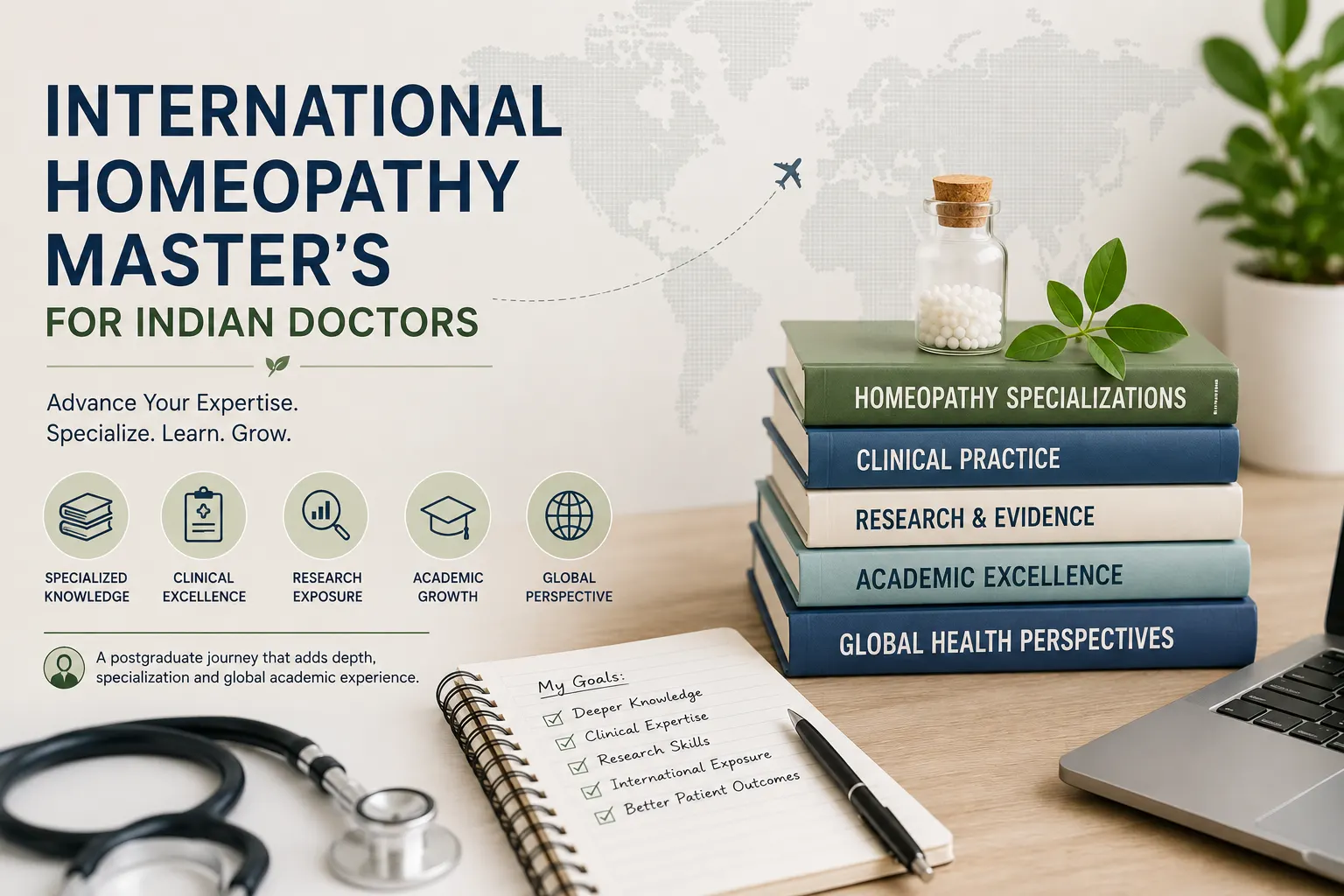
International Homeopathy Master’s for Indian Doctors: What It Adds
Completing BHMS gives a homeopathic doctor a broad professional foundation. But after spending time in practice, many doctors want to go deeper into a particular clinical area, develop stronger academic skills, or explore research.
This is where an international Master’s in Homeopathy can offer something different.
The value is not simply another certificate. For an Indian doctor, the more useful question is:
What additional knowledge, specialization and academic experience can I gain from postgraduate study?
Why Would an Indian Doctor Consider an International Master’s?
India has established pathways for postgraduate Homoeopathy education, including the NCH-regulated M.D. (Homoeopathy) framework. An international postgraduate program can serve a different purpose when it is structured around additional academic specialization.
For a practising doctor, it can provide an opportunity to explore a specialty in greater depth while continuing professional development.
The motivation does not have to be:
“I need another qualification because BHMS is not enough.”
It can instead be:
“I already practise. Now I want to develop deeper expertise in an area that interests me.”
That distinction matters.
What Can an HLMS Master’s Add After BHMS?
HLMS offers postgraduate programs across a range of homeopathy specializations, including dermatology, cardiology, endocrinology, gastroenterology, nephrology and urology, pediatrics, psychiatry and other clinical fields.
For an Indian doctor, this creates an opportunity to move from broad undergraduate knowledge toward a more defined academic specialization.
Instead of studying many specialties at a similar level, you can spend sustained academic time exploring one area.
This can help develop:
- Deeper specialty knowledge
- Structured clinical reasoning
- Case analysis skills
- Research experience
- Academic writing skills
- A defined area of professional interest
The qualification is therefore best understood as an additional postgraduate specialization rather than a replacement for the doctor’s existing BHMS qualification or Indian registration.
The International Element Has Academic Value
Studying through an international institution can expose doctors to perspectives outside their usual academic environment.
This can include different approaches to:
- Specialty education
- Clinical case discussion
- Clinical documentation
- Research
- Academic writing
- Interdisciplinary healthcare
- International professional communication
For a doctor interested in developing an academic or research-oriented career, that exposure can be particularly useful.
The benefit is not that an international qualification automatically creates professional rights in another country.
The benefit is academic exposure and specialization.
You Can Specialize Without Stepping Away From Practice
One practical advantage of an online postgraduate program is flexibility.
A practising doctor may not be in a position to stop seeing patients and return to full-time campus education.
HLMS’s programs are delivered online and structured as 24-month courses. The published course information describes a four-semester, 72-credit structure, with research publications forming part of the program.
That makes the model relevant to doctors who are already professionally active.
The question is not simply:
“Can I study online?”
It is:
“Can I continue practising while systematically developing a specialty?”
For many working professionals, that distinction matters.
The Four-Semester Structure Has a Practical Progression
The HLMS program moves from academic learning toward clinical practice and research.
The first two semesters focus on academic learning, while the latter two incorporate clinical practice and research-paper work.
That creates a progression:
Learn → Apply → Observe → Research
This is particularly relevant for a doctor who already has clinical experience.
The postgraduate journey is not simply about completing theoretical modules. It creates an opportunity to connect specialty-focused learning with clinical application and research.
Specialization Can Change How You Approach Cases
One of the biggest benefits of postgraduate study is depth.
A BHMS graduate may already have encountered patients with dermatological, gastrointestinal, endocrine, neurological or cardiovascular complaints.
Specialization allows the doctor to spend much more time within one clinical area.
That can encourage more structured thinking around:
- medical history
- disease progression
- investigations
- comorbidities
- previous treatment
- follow-up
- clinical outcomes
- referral
HLMS describes its curriculum as involving medical history taking, case studies, critical thinking and problem-solving within the chosen specialty.
For a practising doctor, this can make academic learning more relevant to the cases encountered in practice.
Research Is Another Major Advantage
Postgraduate study can change a doctor’s relationship with research.
Instead of simply reading research papers, the practitioner can learn how to formulate a research question, examine existing literature and develop a structured project.
HLMS’s course information describes research publications as part of its postgraduate structure.
For an Indian doctor interested in academia, this can be an important part of the value proposition.
You are not simply learning a specialty.
You are learning how to ask better questions about that specialty.
It Can Help You Develop a Defined Professional Interest
There is a difference between saying:
“I am a homeopathic doctor.”
and saying:
“My postgraduate academic focus is homeopathic dermatology.”
The second communicates a more defined area of study.
This does not automatically make the doctor an NCH-recognized specialist, and it should not be presented that way.
Academically, however, it gives the doctor a clearer direction.
That can influence the kinds of cases they study, the research questions they pursue, the academic communities they engage with and the continuing education they choose.
What Does CMA Accreditation Add?
HLMS’s postgraduate programs are CMA accredited.
For an Indian doctor, this forms part of the program’s academic accreditation framework.
However, CMA accreditation and NCH recognition are separate matters.
NCH has its own statutory framework for recognition of Homoeopathy medical qualifications and maintains its own Medical Qualification Recognition List.
For this reason, an international postgraduate qualification should be evaluated according to what it actually provides rather than assuming that international accreditation automatically makes it equivalent to an Indian M.D. (Homoeopathy).
For a detailed explanation of recognition, registration and the professional implications of an international qualification in India, see our guide on international homeopathy qualifications for Indian doctors.
What Value Does the Qualification Bring to an Indian Doctor?
For an Indian homeopathic doctor, the most useful way to view an HLMS Master’s is as an additional academic specialization.
It can add:
Specialty Knowledge
A deeper academic focus in a chosen clinical field.
Clinical Learning
An opportunity to work through specialty-focused cases and apply academic learning.
Research Experience
Exposure to developing and documenting research within the chosen field.
International Academic Exposure
Learning through an institution operating outside the Indian postgraduate education system.
Academic Differentiation
A defined area of postgraduate study beyond the doctor’s foundational BHMS education.
These benefits can be valuable even when the qualification is not being pursued as a replacement for an Indian statutory postgraduate medical qualification.
Does This Mean the Qualification Has No Value in India?
No.
Academic value and statutory professional recognition are different things.
An Indian doctor can pursue additional education because they want to:
- understand a specialty more deeply
- strengthen their academic profile
- develop research skills
- explore a specific clinical interest
- build international academic connections
- continue learning while practising
Those are legitimate reasons to pursue postgraduate specialization.
The important thing is to understand the qualification for what it actually provides rather than expecting it to automatically change the doctor’s regulatory status.
Why Transparency Matters
For an Indian doctor considering an international postgraduate program, transparency is a benefit.
You should know:
What is the qualification?
Who accredits it?
What will I study?
What clinical experience is included?
What research will I undertake?
What does it add academically?
What does it not change about my existing registration?
HLMS explicitly distinguishes its academic qualification from professional specialist status and advises graduates not to misrepresent themselves as specialists.
That clarity allows a prospective student to understand exactly what they are investing in.
Is an International Master’s Right for Every Indian Doctor?
No.
If your primary objective is to obtain an NCH-recognized M.D. (Hom.), you should evaluate programs against the NCH’s postgraduate medical education and recognition framework.
But if your objective is to pursue advanced specialization, academic development and research exposure while continuing your professional journey, an international postgraduate program can serve a different purpose.
The right choice depends on what you want the qualification to accomplish.
A Simple Way to Decide
Before enrolling, ask yourself three questions.
Do I want a recognized Indian postgraduate medical qualification?
If yes, investigate the NCH-regulated M.D. (Homoeopathy) pathway.
Do I want deeper specialization in a particular field?
An international postgraduate specialization may be worth considering.
Do I want academic and research exposure alongside my existing practice?
A structured program that combines specialty learning, clinical work and research may be a good fit.
The important thing is matching the qualification to the goal.
What Indian Doctors Can Take Away From an HLMS Master’s
For an Indian homeopathic doctor, the value of an HLMS Master’s is not that it replaces the qualification already earned through BHMS.
It builds on it.
You begin with a broad professional foundation and then choose an area in which you want to go deeper.
You study the specialty.
You work through cases.
You engage with research.
You develop an academic focus.
And you continue building your professional knowledge while remaining clear about the distinction between academic specialization and statutory recognition.
That is ultimately the strongest reason to consider an international postgraduate program.
Not because it promises a new title.
Not because “international” automatically means better.
But because it can give a practising doctor a structured opportunity to go deeper into a field they have chosen to understand better.
Explore HLMS Postgraduate Specializations
Want to see which specialty fits your academic goals?
Explore the available Homeopathic Master’s specializations, course structure and eligibility requirements.
Explore HLMS Specializations →
Frequently Asked Questions
Is an international Master’s in Homeopathy useful for Indian doctors?
It can be useful as an additional academic specialization, particularly for doctors who want deeper knowledge in a chosen field, clinical learning and research exposure while continuing their professional journey.
What does an HLMS Master’s add after BHMS?
An HLMS Master’s adds specialty-focused academic study, clinical learning and research exposure. Available programs cover areas including dermatology, cardiology, endocrinology, gastroenterology, nephrology and urology, pediatrics and several other specialties.
Is the HLMS Master’s the same as an Indian M.D. (Hom.)?
No. The NCH-regulated M.D. (Homoeopathy) is part of India’s statutory postgraduate medical education framework. An HLMS Master’s should not be presented as automatically equivalent to that qualification.
Is HLMS accredited by CMA?
Yes, HLMS presents its postgraduate programs as CMA accredited. CMA accreditation should be understood as part of the program’s academic accreditation and should not automatically be interpreted as NCH recognition in India.
Can an Indian BHMS doctor study an international Master’s while practising?
HLMS programs are delivered online and are designed to support postgraduate study alongside professional commitments. Doctors should continue to comply with the requirements of their existing professional registration and practice.
Does an HLMS Master’s give NCH-recognized specialist status?
No automatic NCH-recognized specialist status should be assumed. The qualification is positioned as an academic specialization, and HLMS advises graduates not to misrepresent themselves as specialists.
Can I use M.Hom. Derm. after completing the HLMS program?
The academic qualification and the professional use of a post-nominal are separate matters. Doctors should verify the applicable professional requirements before using a designation publicly in India. For the detailed regulatory considerations, refer to our guide on international homeopathy qualifications for Indian doctors.
Does the HLMS program include research?
Yes. HLMS course information describes a four-semester postgraduate structure that includes research as part of the program.
What is the main benefit of international postgraduate study for an Indian homeopathic doctor?
The main benefit can be advanced specialty knowledge and academic development. For a practising doctor, the international setting can also provide exposure to different academic perspectives, clinical approaches and research environments.
Should I choose an international Master’s or an Indian M.D. (Hom.)?
It depends on your objective. If you specifically want an NCH-recognized Indian postgraduate medical qualification, evaluate the M.D. (Hom.) pathway. If you are seeking an additional international academic specialization alongside your existing professional qualification, an international Master’s serves a different purpose.