Post Graduate Homeopathy Courses in India: What Every BHMS Graduate Should Check Before Enrolling
India has the largest population of homeopathic practitioners anywhere in the world. It also has one of the most confusing postgraduate landscapes: a mix of government MD seats, private diploma mills, and a growing wave of international online programmes.
Before you commit time and money to any Post Graduate Homeopathy Courses
option, here is exactly what to verify first.
Start With Accreditation, Not Marketing
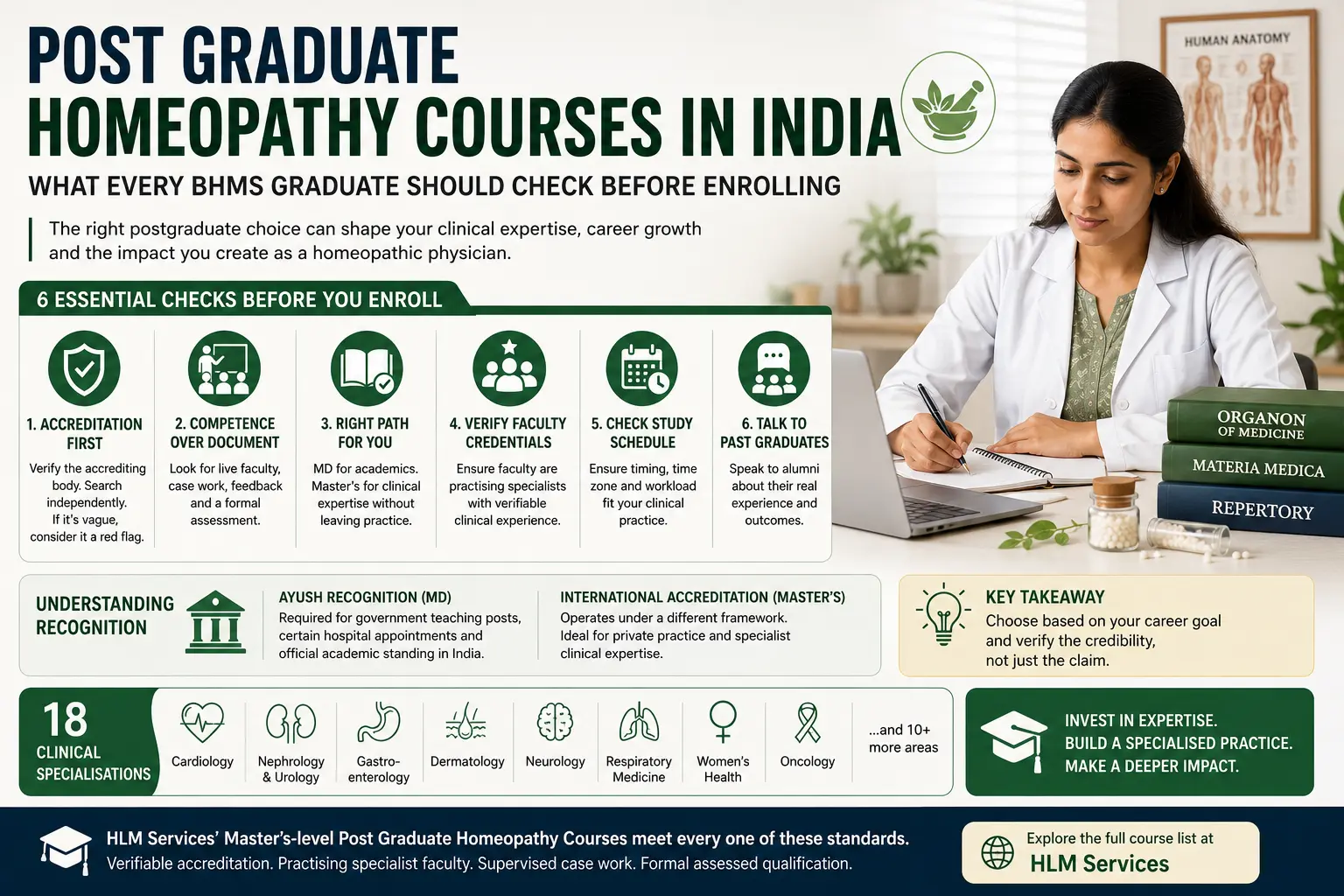
The single most important question is also the most commonly skipped: who actually accredits this programme?
For India-regulated MD programmes, that means AYUSH recognition through a state or central university. For international Master’s-level Homeopathy Post Graduate Courses, that means a verifiable accrediting body outside India not just a claim on a website.
Ask directly for the name of the accrediting body. Search it independently. If a programme is vague about this, treat it as a red flag, not an oversight.
Check Whether the Programme Builds Competence or Just Issues a Document
India’s postgraduate homeopathy market includes everything from rigorous three-year MD programmes to weekend “diploma” courses with no real assessment behind them.
Signs of a Programme Built for Real Competence
- Live faculty sessions led by practising specialists, not recorded content alone
- Mandatory case submission and feedback throughout the programme
- A formal final assessment written exam, viva, or thesis
- A curriculum focused on one clinical specialisation in real depth
Understand Where You Actually Fit: BHMS, MD, or Master’s
Many BHMS graduates in India assume the only postgraduate route is the MD. That assumption costs people years.
The MD remains the right choice if your goal is a government teaching post or departmental leadership inside an Indian institution. But if your goal is deeper clinical expertise in a specific area without giving up your practice for three years an internationally accredited Master’s-level specialisation is built specifically for that situation.
Verify Faculty Credentials Directly
A programme is only as strong as the people teaching it. Faculty should be practising specialists with verifiable clinical experience in the subject they teach not only academics with no current case load.
If you cannot find clear faculty information on a programme’s website, ask directly before enrolling. A credible institution will have nothing to hide here.
Check the Study Schedule Against Your Real Life
Many Homeopathy Post Graduate Courses promise flexibility but deliver a workload incompatible with a full clinic schedule.
Ask specifically: how many live hours per week, what time zone are sessions held in, and how are case submissions scheduled around clinical practice. A well-designed programme will have clear answers to all three.
A Practical Evaluation Checklist
- Is the accrediting body named clearly, and verifiable independently?
- Does the curriculum include real clinical case work, not just lectures?
- Is there a formal assessment at the end of the programme?
- Are faculty credentials publicly listed and verifiable?
- Is the schedule realistic for a working BHMS physician in India?
- Can you speak to past graduates about their actual experience?
Understanding AYUSH Recognition and Where It Applies
AYUSH recognition is specific to India-regulated degrees, primarily the MD (Homeopathy), and governs eligibility for government teaching posts, certain hospital appointments, and official academic standing within India’s public health system.
Internationally accredited Master’s-level programmes operate under a different recognition framework entirely typically governed by the accrediting body’s home jurisdiction. This does not make them less rigorous, but it does mean they serve a different professional purpose. If your goal is a government post specifically, AYUSH recognition through the MD route is non-negotiable. If your goal is private specialist practice, the relevant test is the accrediting body’s credibility, not AYUSH status.
Questions to Ask Before You Pay Any Enrollment Fee
Beyond the general checklist above, a few India-specific questions are worth asking directly before any payment changes hands. Ask whether the institution has previous graduates currently practising in India, and whether you can speak with any of them.
Ask how the institution describes the credential’s status for private practice versus government roles a credible answer will distinguish clearly between the two rather than implying broad equivalence to an MD.
Ask what recourse exists if you are unsatisfied with the programme’s first module reputable institutions are generally transparent about refund or transfer policies, while weaker ones tend to avoid the question.
Comparing Costs Honestly
Government MD seats in India typically involve a comparatively low tuition fee but an extremely high opportunity cost three years away from clinical income. International Master’s-level specialisation programmes typically involve a more direct tuition fee, but no interruption to your clinical income at all.
When evaluating cost, the honest comparison is total cost including lost income, not tuition fee alone. For most practising physicians, the true cost of a campus MD is substantially higher than it first appears.
A Final Word on Due Diligence
None of this checklist is about distrust for its own sake. It is about treating a postgraduate decision with the same rigour you would expect a patient to apply before choosing a treatment path asking direct questions, verifying claims independently, and being comfortable walking away from any institution that cannot answer them clearly.
The institutions worth your time will welcome this scrutiny rather than resist it. A confident, well-built programme has nothing to lose by answering every question on this checklist in detail.
Conclusion
India’s postgraduate homeopathy landscape has real options at every level but also real noise. The difference between a worthwhile credential and a wasted year often comes down to the five checks above.
HLM Services’ Master’s-level Post Graduate Homeopathy Courses are built to meet every one of these standards verifiable accreditation, practising specialist faculty, supervised case work, and a formal assessed qualification across 18 clinical specialisations.
Review the full course list at HLM Services and compare it directly against this checklist.
Frequently Asked Questions
1. Are international Master’s-level homeopathy courses recognised in India?
Internationally accredited programmes are widely respected in private practice and integrative health circles across India. For government teaching roles specifically, the India-regulated MD remains the standard requirement. Always verify accreditation directly with the institution.
2. What is the biggest mistake BHMS graduates make when choosing a postgraduate course?
Assuming “postgraduate” automatically means rigorous. Many short diploma or certificate programmes use postgraduate language without any real clinical assessment behind them. Always check the assessment structure, not just the title.
3. How long do post graduate homeopathy courses in India typically take?
The MD (Homeopathy) runs three years full-time. International Master’s-level specialisation programmes typically run one to two years, delivered largely online.
4. Can I verify a programme’s accreditation myself?
Yes. Ask the institution directly for the name of their accrediting body, then search for that body independently to confirm it is genuine and currently active.
5. Is an online postgraduate course as credible as a campus-based one?
Credibility depends on structure, not delivery format. A well-designed online Homeopathy Post Graduate Courses programme with supervised case work and formal assessment can be just as rigorous as a campus equivalent.
6. What should I ask before enrolling in any post graduate homeopathy course in India?
Ask for the accrediting body’s name, the faculty’s clinical credentials, the case-load requirement, the assessment format, and contact details for past graduates. A credible programme will answer all five without hesitation.
7. Does state-level variation in India affect whether I can use a credential on my clinic signage?
It can. Display rules for postgraduate credentials vary by state medical council in India, so it is worth confirming directly with your local council how a specific qualification can be represented, rather than assuming uniform rules nationwide.