Homeopathic Specialization Courses Explained: What They Actually Teach and Who They’re For
“Specialization course” gets thrown around loosely in homeopathic education; sometimes it means a weekend seminar, sometimes a full academic programme. The difference matters more than the label suggests.
If you are weighing whether a focused programme is worth your time, here is what a genuine
Homeopathic Specialization Course actually involves, stripped of marketing language.
What a Specialization Course Actually Covers
A real specialisation course goes well beyond a general homeopathy refresher. It pairs the conventional pathophysiology of one clinical area kidney disease, skin disorders, digestive conditions with the homeopathic therapeutic approach specific to that area.
This combination matters. Understanding the biology of a condition sharpens your case-taking; understanding the homeopathic materia medica for that condition sharpens your prescribing. Neither alone is enough at a specialist level.
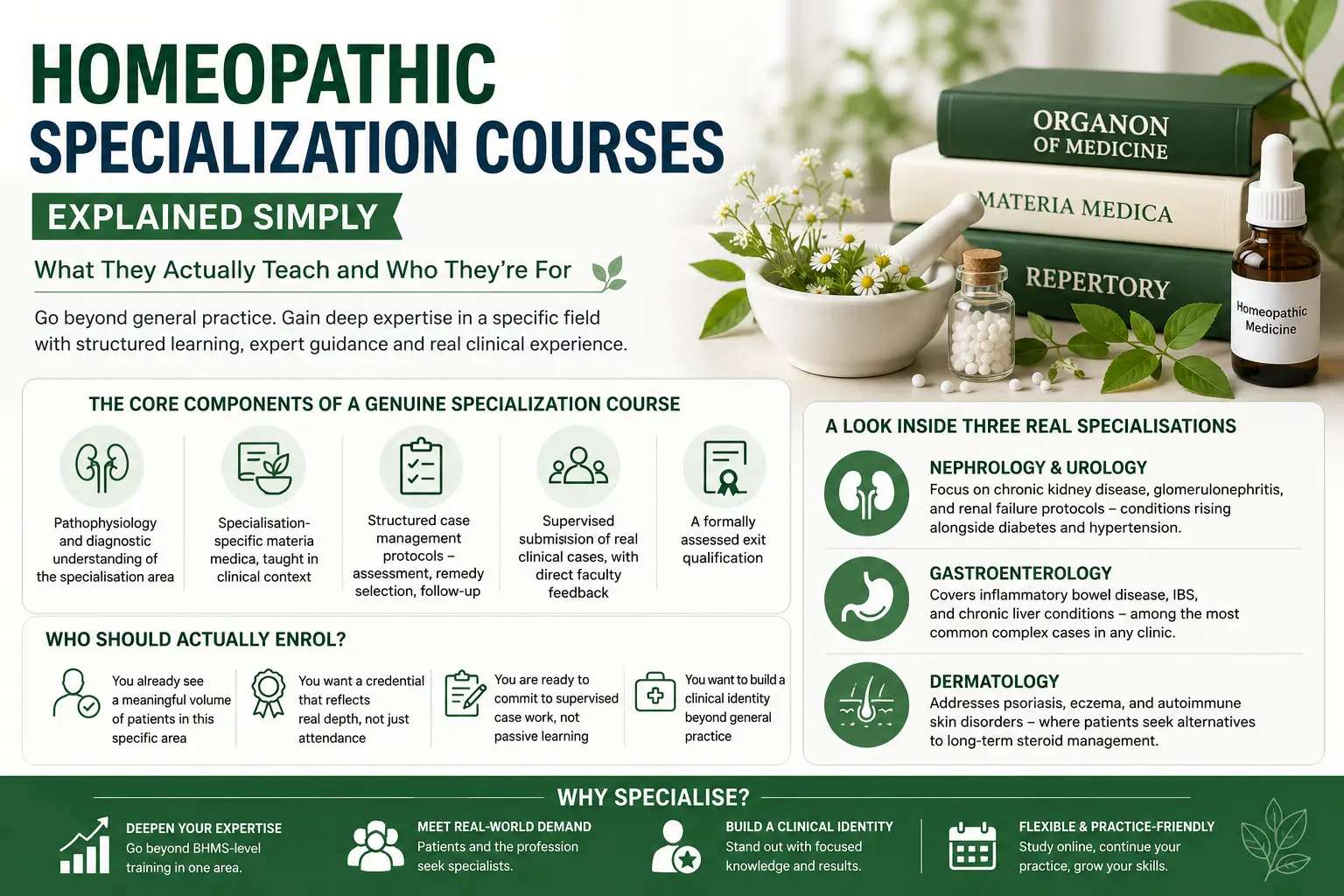
The Core Components of a Genuine Specialization Course
- Pathophysiology and diagnostic understanding of the specialisation area
- Specialisation-specific materia medica, taught in clinical context rather than isolation
- Structured case management protocols assessment, remedy selection, dosing, follow-up
- Supervised submission of real clinical cases, with direct faculty feedback
- A formally assessed exit qualification
Why Specialisation Beats General Revision
General postgraduate study builds a wider foundation, which has its place. But the growing demand from patients and from the profession itself is for practitioners who can demonstrate real depth in one area.
A patient with chronic kidney disease or persistent psoriasis is not looking for a generalist. They are looking for the doctor who has gone deeper than BHMS-level training in exactly their condition.
A Look Inside Three Real Specialisations
Nephrology
Masters in Homeopathic Nephrology & Urology focuses on chronic kidney disease, glomerulonephritis, and renal failure protocols conditions that are rising sharply alongside diabetes and hypertension.
Gastroenterology
Masters in Homeopathic Gastroenterology covers inflammatory bowel disease, IBS, and chronic liver conditions among the most common complex cases in any general clinic.
Dermatology
Masters in Homeopathic Dermatology addresses psoriasis, eczema, and autoimmune skin disorders conditions where patients frequently seek alternatives to long-term steroid management.
Who Should Actually Enrol in a Specialization Course
- You already see a meaningful volume of patients in this specific condition area
- You want a credential that reflects real depth, not just attendance
- You are ready to commit to supervised case work, not passive lecture-watching
- You want to build a clinical identity beyond general practice
How a Typical Specialisation Course Is Structured
Most genuine specialisation programmes follow a similar arc, even though the clinical content differs by subject. The opening months cover foundational pathophysiology building the conventional medical understanding of the condition area before any homeopathic application is introduced.
The middle stretch shifts into specialisation-specific materia medica, taught through real case patterns rather than memorised symptom lists. This is usually where practitioners report the steepest learning curve, since it asks you to connect remedy selection to a much more detailed clinical picture than general training covers.
The final months centre on supervised research submission by you, faculty review your case-taking and prescribing logic, and you adjust based on direct feedback. This cycle repeats several times before the final assessment.
What Makes the Faculty Different in a Genuine Specialisation Course
In a weak programme, faculty are often academics who teach the subject without an active caseload in it. In a genuine specialisation course, faculty are practising specialists doctors who are currently managing the exact conditions being taught, often with years of focused clinical experience in that single area.
This distinction shows up constantly in how questions get answered. An academic can explain what a textbook says about a difficult presentation. A practising specialist can tell you what actually happened the last three times they saw something similar and why their approach changed as a result.
Common Misconceptions About Specialization Courses
One persistent misconception is that specialisation courses are only for practitioners who already consider themselves advanced. In practice, the opposite is often true the practitioners who benefit most are those who feel a specific gap in one area, regardless of how many years they have been in practice.
Another misconception is that a specialisation narrows your practice. In reality, most practitioners keep their general caseload entirely intact the specialisation simply adds a layer of deeper expertise for the patients who specifically need it, while general consultations continue as before.
How to Tell a Specialisation Course Apart From a Marketing Exercise
The clearest test is whether the curriculum could survive being shown to another specialist in that field. A genuine nephrology specialisation, for instance, should hold up to scrutiny from a conventional nephrologist on the pathophysiology content, even though the therapeutic approach differs.
If a programme cannot describe its curriculum in this kind of clinical detail and instead relies on testimonials and broad claims about “transforming your practice” that is a sign the substance behind the marketing may be thin.
How a Specialisation Course Changes Your Patient Conversations
Before specialising, a typical consultation for a complex case often stays fairly general broad case-taking, a remedy chosen from general principles, a wait-and-see follow-up. After specialising, the same consultation usually goes deeper much faster, because you are recognising patterns specific to that condition rather than working from first principles each time.
Patients feel this shift even when they cannot articulate it precisely. A practitioner who asks pointed, condition-specific questions and explains a treatment rationale with real clinical detail builds confidence in a way general consultations rarely achieve.
This is also where professional referrals tend to start. Colleagues notice which practitioners handle a specific condition with unusual depth, and that reputation travels well beyond what any marketing effort could achieve on its own.
Setting Realistic Expectations From Day One
A genuine specialisation course will not make every complex case simple overnight. What it does deliver is a structured framework for approaching that condition area, built from real clinical patterns rather than guesswork which compounds noticeably over the course of the programme and the months following it.
That compounding effect is the real return on a Master’s-level specialisation. It rarely shows up as a single dramatic moment, but rather as a steady, measurable shift in how confidently you handle the cases that once gave you pause.
Conclusion
A genuine Homeopathic Specialization Course is not a weekend seminar with a certificate attached. It is a structured, assessed programme that turns a general BHMS foundation into real clinical authority in one area.
HLM Services offers 18 such specialisations each built on the same standard: real pathophysiology, real materia medica depth, real supervised case work.
Browse all 18 specialisation courses at HLM Services and find the one that matches the patients already walking into your clinic.
Frequently Asked Questions
1. What is the difference between a specialization course and a general postgraduate course?
A general postgraduate course builds broad clinical knowledge across homeopathy. A specialization course goes deep into one clinical area combining pathophysiology, specific materia medica, and supervised case work in that single field.
2. Do I need prior experience in a specialisation before enrolling?
Not formally, but most candidates already see patients with the relevant condition in their practice. This is what makes the learning immediately applicable rather than theoretical.
3. Can I take more than one specialization course?
Yes. Many practitioners complete one specialisation first, then a second once they see how directly it changes their clinical outcomes and patient referrals.
4. Are these specialization courses delivered fully online?
Yes. A genuine online homeopathy course at the specialisation level combines live sessions, case submissions, and assessments all deliverable remotely, without relocating.
5. How is competence actually assessed in these courses?
Through supervised case submissions across the programme, plus a final assessment typically a written examination, viva, or thesis, depending on the institution.
6. Which specialisation has the highest patient demand right now?
It depends on your existing patient base, but nephrology, gastroenterology, dermatology, oncology, and gynecology are currently among the highest-demand areas globally, driven by the rise in chronic and complex conditions.
7. Can I switch specialisations partway through if I realise I chose the wrong one?
This varies by institution, so it is worth asking directly before enrolling. Most well-structured programmes prefer you choose carefully upfront, since the curriculum is built around case work specific to one specialisation, but some allow a transfer early in the programme if genuinely needed.