Master’s in Homeopathy: A Real Alternative to the MD for Practicing BHMS Doctors
You finished your BHMS a while ago. You have a clinic, real patients, and real clinical questions that general training never fully answered.
So you went looking for what comes next. The textbook answer is the MD three full-time years on campus. Beyond that, there’s the PhD, which usually expects an MD first.
What most BHMS graduates are never told is that the MD isn’t the only postgraduate route available. A genuine Master’s in Homeopathy exists as a real alternative not a step before the MD, not a step after it, but a different road entirely, built for a different kind of career.
Why the MD Isn’t the Only Option Even Though It Feels Like It
For most of homeopathy’s modern history in India, postgraduate study came in essentially one shape: the academic MD, tied to government universities and full residency. A research-only PhD sits beyond that, for those who go further still.
The MD was designed for a specific kind of career teaching posts, departmental leadership, institutional research. It was never built around the thousands of practising physicians who simply want deeper clinical expertise in one area, without shutting their clinic for three years to get it.
That’s the population a properly built Master’s-level specialization exists for running alongside the MD as a different choice, not a missing rung underneath it.
What a Genuine Master’s in Homeopathy Actually Means
Not every “Masters” label is the same. A genuine Master’s-level homeopathy qualification is structured, delivered largely online, and built around a single clinical specialization rather than broad theory.
It sits closer in spirit to a specialist fellowship than to a campus degree designed for someone who already has a year or more of practice, not someone deciding their career from scratch.
What Sets a Real Master’s Apart from a Loose Online Course
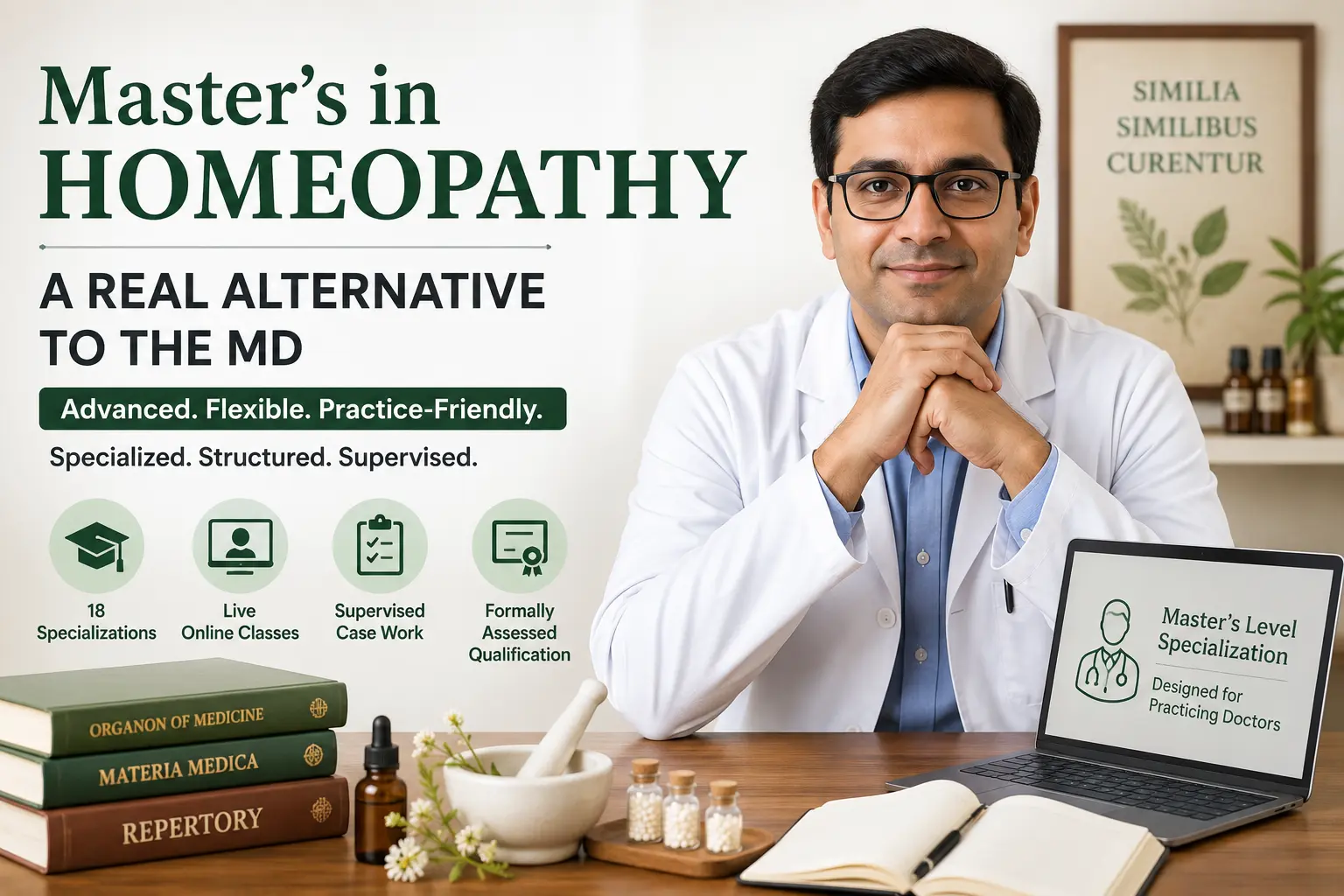
- Live faculty-led sessions, not pre-recorded content alone
- Supervised clinical case submissions at every stage
- A formally assessed final qualification
- Deep focus on one specialization, not a broad refresher
Why Online Delivery Changes the Equation
An MD asks you to relocate or shut your clinic for three years. A genuine online homeopathy course at the Master’s level asks for none of that.
Live sessions, case work, and assessments are built around the schedule of someone who is already practising, not someone with three uninterrupted years to give a university.
This is the structural reason homeopathy training online has grown quickly worldwide: it’s a format genuinely compatible with a working clinician’s life, sitting alongside the MD rather than underneath it.
Who This Path Is Actually Built For
- Practitioners with a year or more of clinical experience who feel the ceiling of general practice
- Doctors who want a specific patient profile chronic disease, complex referrals rather than general cases
- Anyone outside a major university hub with no realistic access to a campus MD
- Practitioners building a focused private or specialty-led practice
Eighteen Specializations, One Underlying Choice
HLM Services offers 18 distinct Master’s-level specialization courses covering everything from cardiology and dermatology to gastroenterology and beyond each one built around the same underlying choice: go deep in a specialty without leaving practice, instead of going broad on campus for three years.
What Happens to Practitioners Who Never Choose Either Path
Walk into any homeopathic conference and you’ll meet two kinds of BHMS graduates fifteen years into practice. One has built a recognisable expertise patients travel specifically to see them for one condition. The other is doing largely what they did in year one, just with more experience behind it.
The difference is rarely talent. It’s almost always whether they found a deliberate way to deepen their knowledge in a focused area, or simply kept practising at a general level because the MD’s three-year campus commitment never felt realistic against a running clinic.
That second outcome isn’t a personal failing. It’s what happens by default when the MD is treated as the only “real” next step when in fact a focused, practice-compatible alternative has been available the whole time.
How This Compares to Specialization in Conventional Medicine
In conventional medicine, a doctor who wants to specialise in cardiology or dermatology has a clear, well-worn path: residency, then fellowship, then board certification in that specific area. Nobody questions whether this is necessary; it’s simply how specialist expertise gets built.
Homeopathy has historically lacked an equally accessible specialist route. The MD functions more like an academic posting tied to a single institution, built for a different goal entirely. A focused, portable specialist credential, something a practising clinician can complete without relocating is what a genuine Master’s-level program offers instead.
This isn’t homeopathy catching up to conventional medicine’s rigour. It’s simply a second, parallel route existing for clinicians whose goals were never about institutional academia in the first place.
What Practitioners Say Changes After Specializing
Ask any homeopath who has completed a focused Master’s-level specialization what changed, and the answer is rarely “I learned a new theory.” It’s almost always about case confidence walking into a complex consultation for a condition they’ve studied in depth, rather than reaching for general principles and hoping they apply.
Patients notice this shift too, even if they can’t name it directly. A practitioner who asks more specific questions, recognises subtler presentations, and explains a treatment rationale with real depth builds trust faster than one working from general training alone.
Over time, this compounds into referral patterns. Colleagues start sending their hardest cases in that specific area your way, simply because they know you’ve gone deeper than they have.
Is This the Right Time for You Specifically?
Timing concerns are reasonable, but they rarely improve with delay. The patients you’re not yet equipped to manage at a specialist level today will still be walking into your clinic next year, and the year after that.
The honest question isn’t “is this the perfect moment.” It’s whether the patients already in front of you justify building real depth in one area and for most practitioners with a year or more of practice, the answer is already yes.
A Note on Choosing Between Specializations
If more than one specialization feels relevant to your practice, resist the urge to pick the one that sounds most prestigious. The strongest starting point is almost always the condition area you already see most frequently; it gives you real cases to apply your learning to from week one, rather than theoretical scenarios you have to wait to encounter.
Conclusion
The choice was never really MD versus PhD, and it was never a sequence where one has to come before the other. For most practising BHMS graduates, the MD’s three-year campus commitment was never realistic to begin with not because the MD lacks value, but because it was built for a different career altogether.
A genuine Master’s in Homeopathy stands as a real alternative real clinical depth, delivered in a format built for the life you’re already living, not a watered-down substitute for the MD.
Frequently Asked Questions
1. Is a Master’s in Homeopathy the same as an MD?
No, and it isn’t meant to replace it either. The MD (Homeopathy) is a campus-based, full-time Indian university degree built for institutional and academic careers. A specialized Master’s is a separate, typically online qualification focused on clinical specialization, a parallel option, not a lesser version of the MD.
2. Can I study while still running my clinic?
Yes, that’s the entire premise of a genuine homeopathy training online Master’s program. Live sessions and case work are scheduled around working hours, so you keep seeing patients while you study.
3. Do I need an MD before I can start a Master’s program?
No. A completed BHMS, generally with a year or more of clinical practice, is the standard eligibility requirement for most Master’s-level specialization courses. The Master’s doesn’t sit downstream of the MD it’s available directly after BHMS, as its own path.
4. Is a specialized Master’s recognised the same way an MD is?
They’re recognised differently because they’re built for different goals. For government teaching roles in India specifically, the MD remains the standard requirement. For private practice, specialty-focused care, and building deeper clinical expertise, a well-structured Master’s-level specialization carries real, growing recognition and always verifies accreditation directly with the awarding institution before enrolling.
5. How long does a Master’s in Homeopathy take?
Most genuine Master’s-level specialization programs run one to two years, combining live instruction, supervised case work, and a final assessed qualification considerably shorter than the MD’s three-year residency.
6. How is this different from a short online certificate course?
A short certificate course is typically theory-only, with no formal clinical assessment. A genuine Master’s-level program requires supervised case submissions and a formally assessed final qualification, a meaningfully deeper commitment and outcome.
7. What if I’m still unsure whether I’m ready for a Master’s-level specialization?
Most institutions, including HLM Services, are happy to discuss your current case load and clinical experience before you commit, so you can make an informed decision rather than guessing. A short conversation with the admissions team is usually enough to clarify whether the timing and the specialization are the right fit.